Galata Bridge Istanbul: History, Restaurants & Visitor Guide
Galata Bridge crosses the Golden Horn between Eminönü on the historic peninsula and Karaköy on the northern shore. It is a working crossing used all day: commuters in suits walk past fishermen casting their lines, vendors sell simit and grilled corn, and the T1 tram runs along the middle of the deck. Walking across is free, and it is one of the easiest places in the city to watch everyday Istanbul life go by.
Pick your date and time: the price of every vehicle is shown on the next step, before you pay. Free cancellation up to 24 hours before pickup.
The History of Galata Bridge
The current Galata Bridge, completed in December 1994, is the fifth structure to span the Golden Horn at this spot. The first recorded bridge over the Golden Horn was Justinian's in the 6th century, further up the inlet. For this crossing, Leonardo da Vinci sent Sultan Bayezid II a bridge design in 1502, the first known proposal for a bridge here, but it was rejected and never built. The first bridge actually built at this point opened in 1845 in the reign of Sultan Abdülmecid I; it was a wooden bridge. A second wooden bridge followed in 1863, then one resting on 24 pontoons in 1875, and a floating pontoon bridge in 1912. The current bridge is a bascule (opening) bridge, 490 metres long and 42 metres wide. The road deck carries two lanes of traffic in each direction, with the T1 tram line in the middle and a walkway on each side.
Fishing from Galata Bridge
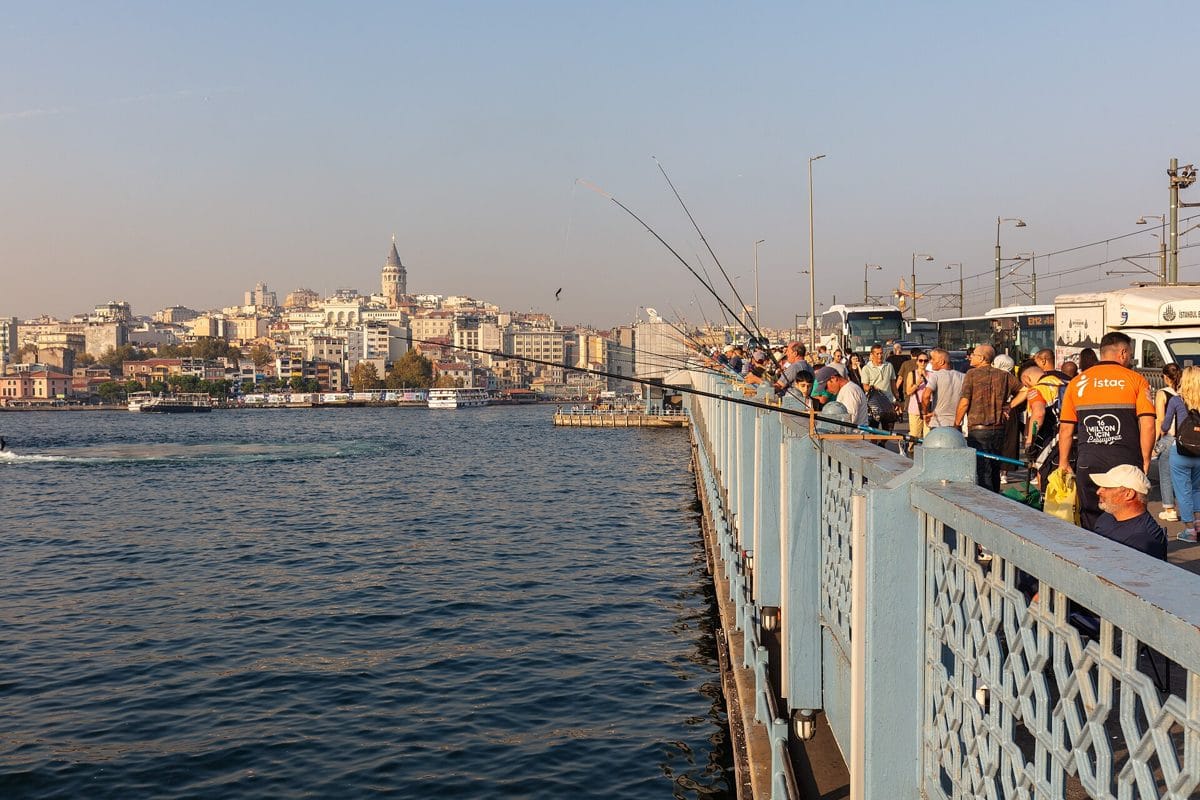
Perhaps the most familiar image of Galata Bridge is the row of fishermen who line the railings at all hours, their rods extending out over the Golden Horn. On a busy day there can be dozens of them. Most of the catch is small fish such as istavrit (horse mackerel), with bluefish (lüfer) in season. Fishing from the bridge is an old Istanbul habit that cuts across age and background: retired men who have kept the same spot for decades stand next to young people trying it for the first time. The fishermen are unhurried and seem unbothered by the traffic, the crowds and the weather. Be careful with your footing and with other people's lines when you walk along the railings.
The Lower Level: Restaurants and Sea Views
Beneath the road deck, a lower level is given over to seafood restaurants. They were added in 2003, modelled on the restaurants under the 1912 bridge, and they run along both sides of the bridge, apart from the central opening span. They serve fish, calamari and mezes, with views over the Golden Horn, the mouth of the Bosphorus, the New Mosque and the Galata Tower. Quality and prices vary from one restaurant to the next, so check the menu prices before you sit down. The lower level is also a covered walkway if you are not eating, and it is pleasant in the evening when the bridge and the city lights reflect on the water.
What to See at Each End of the Bridge
The Eminönü end is one of the busiest transport hubs in the city. Commuter ferries leave from the piers here for Kadıköy and other Asian-shore landings, and Bosphorus cruises also start from Eminönü. At the time of writing (October 2026) the Istanbulkart fare from Eminönü to Kadıköy is ₺65.21. Boats to the Princes' Islands are mostly different: the main Şehir Hatları island ferries leave from Kabataş, and from Eminönü only private Turyol boats (₺230 to Büyükada at the time of writing) and one evening city ferry call. The Spice Bazaar (Mısır Çarşısı) is a two-minute walk from the bridge. It sells spices, dried fruit, Turkish delight and local specialities, and is open daily, Sundays included, from about 08:00 to 19:30. The New Mosque (Yeni Cami) stands right beside the bridge and is open to visitors outside prayer times. The Karaköy end leads into a district of specialty coffee shops, galleries and independent restaurants in old waterfront warehouses, and is where the F2 Tünel funicular and the ferry piers connect. For opening hours and ticket prices of other sights nearby, see our hours and tickets table.
Best Time to Visit Galata Bridge
The bridge is open on foot at any hour, and different times give very different experiences. Early morning, before 8 AM, is the quietest and the light over the Golden Horn is at its best, with the minarets of the historic peninsula above the water. Late afternoon and early evening suit the lower-level restaurants, when the sun sets over the Golden Horn and the city begins to light up. At night the lit bridge and the reflections on the water make a good view. To get here by public transport, the T1 tram stops at Eminönü and Karaköy at each end of the bridge and runs from 06:00 to 00:00. Road traffic is sometimes closed overnight for maintenance, for example from 01:30 to 04:30 in July 2026, so a late-night taxi may have to take another route.
Getting to Galata Bridge from Istanbul Airport
Galata Bridge links Eminönü on the historic peninsula with Karaköy, so it is easy to reach from hotels in Sultanahmet, Sirkeci, Karaköy and Galata. From Istanbul Airport (IST) a private transfer to Eminönü takes about 45 to 75 minutes, depending on traffic on the waterfront road; from Sabiha Gökçen (SAW), on the Asian side, allow about 60 to 90 minutes.
With Airports Transfer Turkey your driver waits just outside the arrivals exit, and after you land they send you the exact meeting point and a short video on WhatsApp. The price is per vehicle and shown before you pay, with no extra charge for traffic or flight delays. See Istanbul Airport to Sultanahmet and Sabiha Gökçen to Sultanahmet for prices.
By public transport the airport coaches, metro and tram are the cheaper options, with changes and luggage to manage. Our guides compare every option with journey times and 2026 fares: Istanbul Airport to Eminönü and Sirkeci, Istanbul Airport to Karaköy and Galata and Istanbul Airport to Sultanahmet.
Related guides: Istanbul Mosques Beyond Sultanahmet
Photo: Diego Delso, CC BY-SA 4.0, via Wikimedia Commons.
You might also like
Visiting Istanbul? We'll Handle the Transfer.
Price per vehicle · Flight tracking · Meet & greet · Booking guarantee online, rest in cash